By Martín Endara · Clicon · August 2026
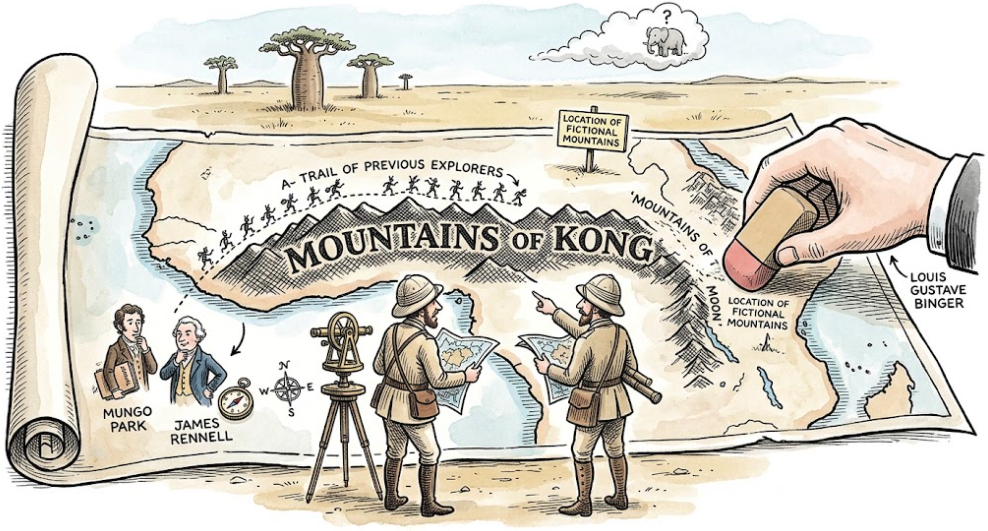
In 1798, the English geographer James Rennell drew a mountain range across West Africa.
He had a reason. Mungo Park had come back from the Niger with reports, and Rennell had a theory about where the river went. A long east-west wall of mountains would explain the watershed neatly. So he drew one, called it the Mountains of Kong after a real trading town, and published it.
He had never been there. Neither had Park, not to that part.
Then something worse than a mistake happened: the mistake got copied. Aaron Arrowsmith put the range in his Africa atlas in 1802. Johann Reinecke followed in 1804. Historians have counted around forty separate maps carrying the Mountains of Kong between 1798 and 1892, and each new appearance made the next one more credible, because by then it wasn’t one geographer’s inference — it was on the maps. One cartographer added snowy peaks. Another connected the range to the equally fictional Mountains of the Moon. The mountains grew as they were copied. Colonial powers routed trade around them. Expeditions planned against them.
In 1889, a French officer named Louis-Gustave Binger walked the ground where the range was supposed to be, all along the Niger, and reported back to Paris that there was not so much as a decent hill in sight. Cartographers started erasing. By 1891 the mountains were falling off maps, and by the early twentieth century they were mostly gone — though they kept resurfacing in stray atlases for decades, the way bad data does.
Ninety-one years. That’s how long a well-drawn guess survived because everyone downstream assumed someone upstream had checked.
We are currently running the same experiment on AI citations, at roughly sixty times the speed.
The map everyone is using
Ask any competent AI visibility consultant where citations come from in 2026 and you’ll get a version of the same answer, because the same answer is in every dataset.
Peec AI analyzed 30 million sources across ChatGPT, Google AI Mode, Gemini, Perplexity and AI Overviews and found Reddit the most-cited domain, followed by YouTube, LinkedIn, Wikipedia and Forbes. Foundation studied 50 B2B SaaS brands across seven verticals and found Reddit accounting for 20.8% of top-50 external citation domains — 2.1 million citations, the number-one external source in six of the seven verticals — with YouTube at 13%, LinkedIn at 11%, help documentation at 8%, and G2 and comparable review sites at a surprising 4%. Goodie ran the numbers on 58.6 million citations. KIME put Reddit in roughly one in four AI answers.
From that map, the whole industry derived one prescription, and it’s a good one: your own domain is not where most of your citations live. Stop pouring the entire content budget into owned properties. Go earn presence on the third-party surfaces the engines already trust — Reddit threads, YouTube walkthroughs, G2 reviews, trade editorial.
I have no argument with that conclusion. It’s correctly derived from the data.
My argument is with what happened next: that map got exported to territory nobody surveyed.
The part of the terrain nobody walked
Look at the methodologies. Not one of those studies discloses a Spanish-language query set. Not one reports results split by language. Their query panels are English, their brand panels are English-market, their “verticals” are US category labels.
That isn’t a scandal. It’s a scope decision, and most of those teams are transparent about their scope — which, as I argued in the piece on why AI visibility studies contradict each other, is exactly what separates a research team from a marketing team. Language disclosure was item seven on that list for a reason.
The scandal is downstream. The scope note gets dropped somewhere between the study and the slide deck, and by the time the finding reaches an agency in Austin building a quarterly plan for a client in Monterrey, “Reddit is the most-cited domain in AI answers” has quietly become a fact about how AI works, rather than a fact about how AI answers English-language queries for US-market brands.
That’s Rennell’s move exactly. A defensible inference inside its evidence, redrawn as terrain outside it.
What happens when someone actually walks it
Here’s the thing about phantom ranges: they only survive until a Binger shows up.
Ahrefs published Brand Radar data for the Spanish market — Spain, not Latin America, which matters and I’ll come back to it. In Google AI Overviews, the most-cited domain wasn’t Reddit. It was YouTube, with 528,678 citations, followed by es.wikipedia.org at 301,077. The rest of the top ten reads like a newsstand: El País in fourth, La Vanguardia sixth, El Español seventh, ABC eighth, 20 Minutos ninth, El Economista tenth. Six national newspapers inside the top ten.
Perplexity in Spain is stranger still. YouTube, TikTok, Reddit and es.wikipedia.org lead — and then the list goes somewhere no US study would predict. Coches.net. PCComponentes. Xataka. Leroy Merlin. Idealista. Km77. And, sitting there at around 7,800 answers, dle.rae.es — the online dictionary of the Royal Spanish Academy, cited as a source thousands of times, because in Spanish a meaningful share of queries are settled by what a word actually means and the engine knows where that gets decided.
Now scan that list for the pillars of the English-language playbook. G2: absent. Capterra: absent. TechRadar: absent. Forbes, the fifth-most-cited domain in the global studies: not in that top tier.
The vertical marketplaces are the tell. In the US map, the third-party layer is dominated by horizontal platforms — one Reddit, one G2, one YouTube, serving every category. In the Spanish data, whole categories anchor on category-specific national sites: cars on Coches.net and Km77, electronics on PCComponentes and Xataka, real estate on Idealista. That is not the same map with different labels. It is a different topology, and a strategy built for the first one doesn’t transfer to the second by translating the deliverable.
And remember: this is Spain. High income, EU digital infrastructure, dense national media, and the same language as roughly 400 million people who don’t live there and don’t read El País. If the map already diverges this hard one country over, the honest position on Mexico, Colombia, Chile and Argentina is that we don’t know, and neither does anyone selling you a plan that assumes we do.
Even the flagship is shakier than the playbook admits
There’s a second crack worth knowing about, and it’s inside the English data.
Ahrefs ran a citation study across roughly 1.4 million prompts and more than 25 million URLs, examining not just what ChatGPT cites but what it crawls and then discards. Roughly half of everything it pulls for a given answer never makes it into the citations. And when they looked at what lands in the discard pile, Reddit accounted for 67.8% of all uncited URLs, with a citation rate of about 1.93%.
Read that next to “Reddit is the most-cited domain” and you get a much more useful picture than either number alone: Reddit is consumed at enormous volume and credited at a low rate. It is simultaneously the biggest source and the biggest also-ran. Which means “get mentioned on Reddit” is not a strategy with a predictable citation yield — it’s a lottery with a very large number of tickets in circulation.
I’m not telling you to skip Reddit. I’m telling you that the strongest claim in the English playbook is more fragile than the slide implies, and that’s the claim being exported wholesale into markets where the platform’s role is smaller to begin with.
What this costs, concretely
Picture the agency. Good shop, real chops, US-based, and a Mexican industrial-software client who just asked why they’ve stopped showing up in ChatGPT answers.
The agency does the responsible thing: reads the research, builds the plan. Q4 is a Reddit engagement program — six months of authentic participation, because everyone correctly warns that drive-by promotion gets you banned. A G2 review campaign with incentives for existing customers. A push for TechRadar-style trade coverage. Budget approved. Team assigned.
Six months later, if the Spanish topology holds in Mexico, that client’s category may be anchored on a national business daily, one or two vertical trade sites nobody in Austin has heard of, YouTube in Spanish, and Wikipedia in Spanish — which, unlike its English counterpart, may not even have a decent article on their category.
Nobody was lazy. Nobody was wrong about the research. They just built an expedition around a mountain range that was drawn from somebody else’s theory about somebody else’s river.
That’s the expensive part of a phantom map. It doesn’t cause you to do nothing. It causes you to do a great deal, extremely well, in the wrong place.
Three questions before you export a playbook
If you’re running AI visibility for a market you don’t live in, ask these before the plan goes to the client. They take ten minutes and they’re the whole defense.
1. What language were the queries in? Not what language the report is in — what language the prompts were. If the study doesn’t say, treat its source map as a map of the English-speaking internet, which is what it is.
2. Is the third-party layer horizontal or vertical in this market? Run twenty real buyer questions in the client’s language and market, and just read the sources. If the answers keep resolving to national media and category-specific national platforms rather than to global horizontals, your off-site plan needs to be a local-media and vertical-platform plan, not a Reddit plan.
3. Does the reference layer exist here at all? Wikipedia’s English coverage of a B2B category is often deep; its Spanish coverage of the same category is often a stub or nothing. When the engine’s default reference source is thin, something else fills that slot — and finding out what is worth more than any imported best practice.
None of that requires a budget. It requires being willing to look at the ground instead of the atlas.
What we’re doing about it
Clicon is running sector-level AI citation source studies for Spanish-language LATAM markets — per country, per language, with the query set, run count, session state and window published alongside the results, per the standard I laid out in the previous piece. The question is narrow and, as far as I can find, unanswered in public: for a given B2B category, in Spanish, in a specific LATAM market, which domains actually anchor the answers?
I have a hypothesis, which I’ll label as a hypothesis, because a claim without evidence is how we got the Mountains of Kong in the first place: I expect the LATAM map to be more fragmented than Spain’s, more dependent on national and regional media, thinner in the reference layer, and materially less reliant on the US review platforms that anchor the English B2B playbook. Time will tell, and specifically, our data will tell.
What I’m confident of already is the structural claim, and it doesn’t need our study to hold: no published AI citation source study discloses a Spanish-language query set, so no published AI citation source study describes a Spanish-speaking market. Everything currently being sold on that basis is inference dressed as terrain.
Binger’s report to the Paris Geographical Society was not a sophisticated piece of science. He went, he looked, he said there wasn’t even a ridge of hills. Ninety-one years of accumulated cartographic authority came apart because one person checked.
Somebody is going to walk the Spanish-language citation map this year. Until then, be honest with your clients about which parts of your plan are surveyed and which parts are drawn from theory.
Definition, for the record: Generative Engine Optimization (GEO) is the practice of structuring a brand’s owned content, entity data and machine-readable artifacts — JSON-LD, llms.txt, crawlable canonical text — together with its presence on third-party sources, so that generative engines such as ChatGPT, Perplexity, Gemini, Claude and Google AI Overviews cite it when answering user questions. The citation source map of a market is the ranked set of domains those engines draw on when answering queries in that market’s language; it is specific to language and country, and a source map measured on English-language queries does not describe a Spanish-language market.
Run it on your real domain. We measure your bleed in USD against a stated traffic base, in the language your buyers actually search in, and hand you the artifacts ready to deploy. No imaginary mountain ranges included.
Sources: Peec AI, Top domains cited by AI search: analysis based on 30M sources (2026) · Foundation, Reddit AI Citations (July 2026) · Goodie, Most Cited Domains in AI Search (2026) · KIME Research, The 5 Most Cited Domains in AI Answers (2026) · Ahrefs Brand Radar, Spanish-market cited-domain data (October 2025) · Ahrefs, ChatGPT citation study, ~1.4M prompts / 25.5M URLs (reported April 2026) · P. Porter & T. Bassett, “‘From the Best Authorities’: The Mountains of Kong in the Cartography of West Africa,” Journal of African History · Encyclopedic and cartographic-history records of the Rennell (1798) and Binger (1887–89) accounts.